The (perhaps hasty) assumption that conspiracy theory deniers are not a spook-stooge becomes evidence in favour of such theories.
Un-initiated, and without conscious inducement they defend such organisations as may exist.
By
induction this may apply to various degrees at various levels, each
person doing what they think is right and natural, a little self serving
here and there - but selected because their resultant actions are
convenient.
If you want a deed doing, find someone who wants to
do the deed and let them do what they want. No direct commuication or
coercion required. Their visible well meaning is all the better a
disguise.
The strength of any conspiracy theory is it's veracity which trumps all so-called weaknesses.
Veracity
is naturally hard to measure, particularly against a weakness of the
defensibility of a theory when mistaken for a weakness of the theory.
A weakness of the theory would relate to difficulty for the parties of the theory to act according to the theory.
A
weakness of the defensibility of the theory would be an implausibility
of the theory which depends largely on the experiences of the listener
and less on the theory itself.
What works wins. Does there have
to be a grand design, or will natural selection work? or is that the
grand design? I note that some players win many games of chess despite
the implausibility of long term prediction of the opponents moves.
Let
the hungriest power mongers fight it out, and nudge to authority those
who can be led by their desires. And then lead them. That's the world we
live in, and it has typically been so.
I happen to believe that
the one with the most power is good, known as God, who does not enforce
but rather invites, who can deliver the captives of the mighty and the
prey of the terrible. This does not absolve me of responsibility but rather realises it.
And this is why I like Christmas.
The birth of the one who was not deceived, who followed the will of the
Father and provides the means to escape for all who will.
Hows that for a Christmas sermon? I can't apologise - for the ideas are inseparable; we can't save ourselves.
I
think that a typical defence against truth is to find a reason not to
listen. We cannot bear the horror of the world we live in, and pretend
it is just about starving orphans in war torn droughts, attacks on the
liberty of good manners and lazy rich people who've taken all the money.
Showing posts with label philosophy. Show all posts
Showing posts with label philosophy. Show all posts
Tuesday, 9 December 2014

Monday, 1 September 2014
Corollary to Hanlons Razor
Hanlon's razor is an eponymous adage that allows the elimination of unlikely explanations for a phenomenon. It reads:
The corollary is: The malicious will hire stupid fools to do their bidding.
Which then leads to: The first rule of choosing a a good stooge is to find one who for reasons of his own already wanted to do whatever it is you were to ask.
And therefore: Watch out for those who appoint stupid fools without a sound justification
Never attribute to malice that which is adequately explained by stupidity.
The corollary is: The malicious will hire stupid fools to do their bidding.
Which then leads to: The first rule of choosing a a good stooge is to find one who for reasons of his own already wanted to do whatever it is you were to ask.
And therefore: Watch out for those who appoint stupid fools without a sound justification
Wednesday, 7 May 2014
Passive Aggression
This essay so far only covers passive-aggressive as a defence against the narcissistic psychopath, and not as a method of attack used by the narcissistic psychopath, or as a substitute means of communication.
Arguably, this is not true passive aggression but rather a refusal to engage. For a fuller look at passive aggression, see http://www.theguardian.com/science/brain-flapping/2015/feb/19/ok-dont-read-this-article-about-passive-aggressive-behaviour-honestly-its-fine
Arguably, this is not true passive aggression but rather a refusal to engage. For a fuller look at passive aggression, see http://www.theguardian.com/science/brain-flapping/2015/feb/19/ok-dont-read-this-article-about-passive-aggressive-behaviour-honestly-its-fine
Passive Aggression
Passive-aggressive: Term for practitioners of non-violent inaction, employed by those who have not yet discovered the futility of ridicule against the practice.
Introduction
Much so-called passive aggression is not so much aggression, as dis-interest.
The accusation of passive aggressive is the last attempt of the psychopath to manipulate and dominate those who have made the ultimate withdrawal from a hostile environment, by refusing to participate.
It's older equivalent from the age of physical violence, which may still be familiar to some, is: "Come back and fight me you snivelling little coward!" or as it was understood by the hearer: “Come back so that I can beat you into submission!”
Those whose eloquence or tired persistence have crumbled before the illogical, unreasonable and unremitting demands of the exploitative bully have concluded that the only way to win is not to play the game; that validation from the psychopath is unsatisfying, that the promise of validation is unbelievable, that while yielding may defer immediate pain into future pain, playing the game only promises pain.
And what's wrong with passive-aggression, if we can call it that? How about calling it non-violent inaction? Does one really prefer passionate aggression, or violence? And does one leave place for those who don’t?
Victim-blaming
The accusation of passive-aggressive is an attempt to blame failure to engage, or to kindle even the smallest spark of trust, on the one whose engagement is to be exploited.
Having spent every cent of political capital, the passive-aggressive-accuser will attempt to bully-up some more, revealing themselves as a psychopathic snake-head demanding the privilege to present, ad-infinitum, scenario after scenario until they can find one that will cause the other to willingly do their bidding.
Preferred Environment
Those who prefer passionate aggression may thrive in an environment of passionate aggression. It may be that they think that they are the most aggressive and persistent and that they can dominate that environment and “do things right” (because, “Hey! If I was wrong, I would have changed my mind”)
Likewise one might expect that those in favour of actual aggression also suppose themselves to be among the biggest and the strongest.
One might suppose that PA accusers are attempting to perpetuate an environment in which (actual violence being outlawed) they can win by force of personality, while simultaneously preventing their victims from carving out a sanctuary of their own.
What does the passive-aggressive see?
The passive-aggressive’s behaviour silently says: “Why should I be interested in your little scheme? I’m not a resource to be exploited to your ends!”, but has somehow found it no longer worthwhile to say this out loud. It is not worthwhile to provide the psychopath with feedback how to constructing a more effective message/weapon.
The passive-aggressive sees no union, no meeting of the minds, except perhaps superficially.
The psychopath will offer scenarios that ostensibly are desirable to both parties based on the superficial union, but the passive aggressive is aware of an additional cost that is too expensive to explain.
How to deal with a passive aggressive
Take some actual real unselfish interest in the welfare and independence of the passive aggressive.
If you find that this doesn’t work then it wasn’t really unselfish, just more latent psychopathy.
Clue: it’s not supposed to work, what were you actually trying to do? Try granting the other person a little self-sovereignty.
Not passive, just hidden?
It isn’t all non-violent inaction though. Here are some classic petty revenges.
The revenge must be perfectly balanced, the punishment must fit the crime.
So is passive-aggressive nature or strategy? How are latent psychopathic in all of us manifest when we are not in a position to get caught by those who matter?
So is passive-aggressive nature or strategy? How are latent psychopathic in all of us manifest when we are not in a position to get caught by those who matter?
Monday, 27 January 2014
A Plea for Social Equality
True democratic wealth is time: everybody has 24 hours of it a day.
The significant social inequality of the day is that some peoples time is not exchangeable for much value, while other peoples time is very much in demand and exchangeable at a high rate.
I simplify somewhat, for a person can sometimes exert control over their exchange rate by means of how much effort they put in; but even at maximum effort there is still a large disparity between the exchangeable values of the time of different people, or in different locations.
In the corrupt imperial west there is a notion that 8 hours of effort per day should be exchangeable for necessities of life (and some discretionary comforts) but the opportunity to make this exchange is not granted equally to all people (and nor is the standard of life).
In the name of social conscience and humanity, this inequality is often reasonably addressed by moving a surfeit of value from those who found favourable exchange, to those who who found a poor rate of exchange.
Yet paradoxically, the extreme inequality of those who found no exchange is addressed by an attempt to provide the value of life necessities with no exchange required.
This does not introduce equality but instead introduces further inequality for in transferring the surfeit of value to those who find no exchange, it leaves them with a surfeit of time. It reduces them to the status of beggar and provides no way to contribute.
It would be more equitable to provide opportunity of exchange to those who found no exchange, making all equal contributors to society from the universal and collective wealth of time, and condemning none to the status of beggar.
TLDR: Or in other words, why in the UK when taxes are going up, and public works are going down, why, are we paying people to do nothing?
It is no socialist triumph to lose the working class and gain another idle class (however unwilling).
Let the time of each be valued equally - sufficient for life, and let all contribute.
And here's hoping for a shorter working day for all, enough time for dancing and singing.
The significant social inequality of the day is that some peoples time is not exchangeable for much value, while other peoples time is very much in demand and exchangeable at a high rate.
I simplify somewhat, for a person can sometimes exert control over their exchange rate by means of how much effort they put in; but even at maximum effort there is still a large disparity between the exchangeable values of the time of different people, or in different locations.
In the corrupt imperial west there is a notion that 8 hours of effort per day should be exchangeable for necessities of life (and some discretionary comforts) but the opportunity to make this exchange is not granted equally to all people (and nor is the standard of life).
In the name of social conscience and humanity, this inequality is often reasonably addressed by moving a surfeit of value from those who found favourable exchange, to those who who found a poor rate of exchange.
Yet paradoxically, the extreme inequality of those who found no exchange is addressed by an attempt to provide the value of life necessities with no exchange required.
This does not introduce equality but instead introduces further inequality for in transferring the surfeit of value to those who find no exchange, it leaves them with a surfeit of time. It reduces them to the status of beggar and provides no way to contribute.
It would be more equitable to provide opportunity of exchange to those who found no exchange, making all equal contributors to society from the universal and collective wealth of time, and condemning none to the status of beggar.
TLDR: Or in other words, why in the UK when taxes are going up, and public works are going down, why, are we paying people to do nothing?
It is no socialist triumph to lose the working class and gain another idle class (however unwilling).
Let the time of each be valued equally - sufficient for life, and let all contribute.
And here's hoping for a shorter working day for all, enough time for dancing and singing.
Sunday, 3 February 2013
Forgiveness
I post this to point out that forgiveness isn't something available on demand, and also the dangers of letting the perpetrator define what forgiveness does and does not mean.
It can take the victim longer to work out forgiveness than it took the culprit to commit the offences and finally achieve a change of heart. This is something a repentant perpetrator may or may not be able to comprehend.
For example I might finally forgive my accountant for ripping me off and dashing my dreams and losing my house, but I wouldn't give him the chance to do it again, and I don't expect to be able stop suffering the injury and seeking revenge and punishment at his demand and admission. It would take time and effort and more time and more effort.
In other words I can eventually stop suffering from the injury, and I can eventually stop seeking revenge and punishment. But I don't have to give him access to my bank account in order to prove to him that I have reached or am trying to reach that state.
If someone thinks I haven't forgiven them, then that is their problem whether or not they are right. They just might have to forgive me.
Only the innocent victim knows what forgiveness entails, and only the repentant perpetrator wants it badly enough to wait for it.
And, for accuracy, there is one truly innocent victim who provides the means of healing and forgiveness for the injured and the guilty; when they want it badly enough to receive it.
It can take the victim longer to work out forgiveness than it took the culprit to commit the offences and finally achieve a change of heart. This is something a repentant perpetrator may or may not be able to comprehend.
For example I might finally forgive my accountant for ripping me off and dashing my dreams and losing my house, but I wouldn't give him the chance to do it again, and I don't expect to be able stop suffering the injury and seeking revenge and punishment at his demand and admission. It would take time and effort and more time and more effort.
In other words I can eventually stop suffering from the injury, and I can eventually stop seeking revenge and punishment. But I don't have to give him access to my bank account in order to prove to him that I have reached or am trying to reach that state.
If someone thinks I haven't forgiven them, then that is their problem whether or not they are right. They just might have to forgive me.
Only the innocent victim knows what forgiveness entails, and only the repentant perpetrator wants it badly enough to wait for it.
And, for accuracy, there is one truly innocent victim who provides the means of healing and forgiveness for the injured and the guilty; when they want it badly enough to receive it.
Friday, 18 January 2013
A word on Technicalities
I read a comment from a chap who didn't care at all about technicalities but just thought people should pay their share of tax.
He didn't understand that it is the technicalities that make it possible to know what one's share of tax is so that one can pay it.
I think he felt like a benevolent dictator who could whip people into paying their share, but didn't realise the chaos that would ensue when the dictator next to him did the same thing but with a slightly different idea of what the share should be.
It was a sad case of the dangerous liberal dictators which goes like this: "If only everyone would do it my way it would all be so much better and we'd all get along so nicely."
It also reminds me of the more rabid US anti-gun folk who steam away thinking: If only we could MAKE them give up their guns, the country would be more safe and more peaceful; but without realising that they would have to MAKE them like it too, which is no more possible than making the anti-gun chaps like guns.
In other words: We only have these hard conversations because agreement is hard. Yet another attempt to sweep away disagreement isn't going to work.
Technicalities bring peace and order to confusion and disagreement without the need for full agreement.
It is sometimes easier to agree on technicalities than on principle; and that is what politics is, although in politics often the principle is not so much at stake as is who will get the bigger slice of pie.
He didn't understand that it is the technicalities that make it possible to know what one's share of tax is so that one can pay it.
I think he felt like a benevolent dictator who could whip people into paying their share, but didn't realise the chaos that would ensue when the dictator next to him did the same thing but with a slightly different idea of what the share should be.
It was a sad case of the dangerous liberal dictators which goes like this: "If only everyone would do it my way it would all be so much better and we'd all get along so nicely."
It also reminds me of the more rabid US anti-gun folk who steam away thinking: If only we could MAKE them give up their guns, the country would be more safe and more peaceful; but without realising that they would have to MAKE them like it too, which is no more possible than making the anti-gun chaps like guns.
In other words: We only have these hard conversations because agreement is hard. Yet another attempt to sweep away disagreement isn't going to work.
Technicalities bring peace and order to confusion and disagreement without the need for full agreement.
It is sometimes easier to agree on technicalities than on principle; and that is what politics is, although in politics often the principle is not so much at stake as is who will get the bigger slice of pie.
Thursday, 10 May 2012
Why we have a recession:
When you borrow money to spend, you are spending tomorrows money today and agreeing that you will therefore not be able to spend it tomorrow.
It's now tomorrow.
Today's money was spent by the labour government along with yesterdays money.
While cutting back spending won't "recover the economy" right now, there isn't actually much left to spend. Borrowing even more will just rob our children of even more of their future.
If you think spending is important to maintain the economy, then don't spend tomorrows money today - or you can expect a bleak tomorrow.
Did I mention that it is tomorrow?
Labour have been very generous to you and your friends by maxing out your credit card.
Tuesday, 8 May 2012
Dolphins and Discrimination
I wrote this allegory to capture observations on discrimination that would not be safe to utter plainly. There are at least three lessons here.
(C) Sam Liddicott 2012
There were some Dolphins on the windward side of an Island. Like most dolphins, they sometimes behaved aggressively toward each-other.
There were some Dolphins on the leeward side of the Island. Like most dolphins, they sometimes behaved aggressively toward each-other.
In time, some of the windward dolphins became particularly aggressive towards the leeward Dolphins, for no other reason than that they were leeward dolphins, and often hunted them out, or ganged up to attack lone dolphins. This became a particular concern for the leeward Dolphins who began to question their own aggressiveness between each-other.
In time, the attacks of the windward dolphins became so aggressive that the leeward dolphins would often be severely wounded or killed. Sometimes the leeward Dolphins would respond with violent attacks of their own but these did little to change the persistent behaviour of some of the windward dolphins.
When the continual violence of the windward dolphins became too much to bear, the great dolphin sent an Orca to deliver this message:
That although they were all brothers, the windward dolphins would in future be reborn as leeward dolphins, both to experience the effects of their behaviour and perhaps in time to temper the violence of the windward dolphins to their own reborn brothers.
The leeward dolphins were horrified when they heard this. They idea of living with and sharing life and love with those who had so badly treated them - and not be able to recognise them - was repugnant to them and made light of their injuries (they said).
Don't worry, said the orca, they will continue to behave violently towards those who do not appear the same as themselves, and so you will know who they are. Don't hate them, or you may become like them; love them because they will also protect you from the windward dolphins.
I count at least three morals in this tale.
Dolphins - an allegory on discrimination
(C) Sam Liddicott 2012
sam@liddicott.com
There were some Dolphins on the windward side of an Island. Like most dolphins, they sometimes behaved aggressively toward each-other.There were some Dolphins on the leeward side of the Island. Like most dolphins, they sometimes behaved aggressively toward each-other.
In time, some of the windward dolphins became particularly aggressive towards the leeward Dolphins, for no other reason than that they were leeward dolphins, and often hunted them out, or ganged up to attack lone dolphins. This became a particular concern for the leeward Dolphins who began to question their own aggressiveness between each-other.
In time, the attacks of the windward dolphins became so aggressive that the leeward dolphins would often be severely wounded or killed. Sometimes the leeward Dolphins would respond with violent attacks of their own but these did little to change the persistent behaviour of some of the windward dolphins.
When the continual violence of the windward dolphins became too much to bear, the great dolphin sent an Orca to deliver this message:
That although they were all brothers, the windward dolphins would in future be reborn as leeward dolphins, both to experience the effects of their behaviour and perhaps in time to temper the violence of the windward dolphins to their own reborn brothers.
The leeward dolphins were horrified when they heard this. They idea of living with and sharing life and love with those who had so badly treated them - and not be able to recognise them - was repugnant to them and made light of their injuries (they said).
Don't worry, said the orca, they will continue to behave violently towards those who do not appear the same as themselves, and so you will know who they are. Don't hate them, or you may become like them; love them because they will also protect you from the windward dolphins.
I count at least three morals in this tale.
Tuesday, 6 September 2011
The sad state of buying sheet music online
I've been trying to buy some sheet music online. I've found a few places who will sell me the music if I will download and install their special sheet music viewing software.
What?
I want to buy something from them I don't want to start a relationship with them. Why would I want to download their software just to be able to buy something from them?
I think the software is designed to stop me printing more copies than I pay for...
What?
Like I don't know how to print-to-file and then do as many copies as I like. As if I don't have a "print-to-pdf" printer driver as well. As if I didn't have a document-feeder-printer-scanner-fax-machine-copier right next to me like most of us have these days (and a simple scanner would have been enough).
I finally bought my sheet music from Freehandmusic.com and instantly regretted it - as far I was able to tell their distinguishing feature was that they don't warn about the special software until AFTER the music has been paid for. It's possible they do warn about it but I didn't see any warnings, even at checkout time.
But I didn't use it. I did get a refund.
Of course their special treat-everyone-like-a-thief software doesn't run on my computer anyway.
Without too much trouble and while looking for someone who would sell it in pdf form able to find some illegal pdf-scans of the music I was trying to buy.
So my choice is illegal music or nothing. And I'm trying to pay.
So I chose nothing.
Remind me why the music industry is struggling again...
What?
I want to buy something from them I don't want to start a relationship with them. Why would I want to download their software just to be able to buy something from them?
I think the software is designed to stop me printing more copies than I pay for...
What?
Like I don't know how to print-to-file and then do as many copies as I like. As if I don't have a "print-to-pdf" printer driver as well. As if I didn't have a document-feeder-printer-scanner-fax-machine-copier right next to me like most of us have these days (and a simple scanner would have been enough).
I finally bought my sheet music from Freehandmusic.com and instantly regretted it - as far I was able to tell their distinguishing feature was that they don't warn about the special software until AFTER the music has been paid for. It's possible they do warn about it but I didn't see any warnings, even at checkout time.
But I didn't use it. I did get a refund.
Of course their special treat-everyone-like-a-thief software doesn't run on my computer anyway.
Without too much trouble and while looking for someone who would sell it in pdf form able to find some illegal pdf-scans of the music I was trying to buy.
So my choice is illegal music or nothing. And I'm trying to pay.
So I chose nothing.
Remind me why the music industry is struggling again...
Monday, 6 June 2011
Good intentions / good actions
This analysis highlights the difference between good intentions and good actions.

Oxfam's latest campaign, "Grow", seems so lovely and cuddly that to criticise it is almost like torturing puppies. What could be wrong with trying to feed the hungry and thus make the world a better place? Alas, if wishes were kings we could all be monarchs for the day and what's wrong with the campaign is not the initial wish but the list of damn fool things it intends to do.
Saturday, 4 June 2011
What makes the improbable valuable
When what makes a thing improbable also makes it valuable, the description "unlikely" is not helpful. Singular claims must be examined independently. That which is not normal makes life meaningful and worthwhile. Here are two good uses of the word "absolutely" to describe some singular events. My favourite paragraph: "How the Atonement was wrought we do not know. No mortal watched as evil turned away and hid in shame"
http://lds.org/pages/necessity
http://lds.org/pages/necessity
Monday, 30 May 2011
Rationality?
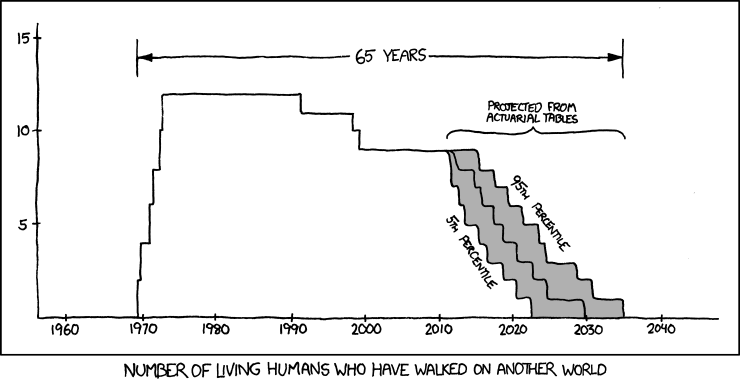
Rationality... hmm... it affects more than just the individual. See link, with the hidden message (hover over the image) quoted here:
"The universe is probably littered with the one-planet graves of cultures which made the sensible economic decision that there's no good reason to go into space--each discovered, studied, and remembered by the ones who made the irrational decision."

"The universe is probably littered with the one-planet graves of cultures which made the sensible economic decision that there's no good reason to go into space--each discovered, studied, and remembered by the ones who made the irrational decision."
Thursday, 5 May 2011
How do you know there is a god
Apart from the confusion that the person asking the question doesn't usually define god the same way the person answering the question does, and apart from discussion on what know means and the meaning of means the question raises some very interesting points.
Who knows?
Often the questioner asking "How do you know...", "yes, but how do you know?" is really asking this slightly different question "but how can I know that you know?" or "how can I know that you know that you are not deluding yourself?" and this is often apparent from their dissatisfaction with the answers given, showing that it is themselves that they wish to satisfy that you know.
Who knows what?
The larger question we notice, is this: Is it possible for someone to know that you know that there is a god without themselves then also knowing that there is a god? I don't think so.
Or, is it possible for someone to know that it is possible to know that there is a god without also simultaneously knowing that there is a god?
More simply: Is it possible to know that a test-for-god is a valid test without knowing the results of the test?
If it isn't possible, then it may be impossible for the question "yes, but how do you know there is a god" to ever be satisfied without the questioner submitting to the test-for-god.
Is there?
Of course is seems reasonable that the person claiming knowledge of god is lying or mistaken. Careful scrutiny by the questioner may reveal the lie or the mistake, but this would cast no light on the existence of a god, only on the character of the believer.
The answer
The answer of the believer is "You can't know that I know." and maybe also "but you can know for yourself."
Of course, this second point is only true if we inhabit a universe in which there actually is a god who is willing to reveal himself, and who presumably will be the one to dictate the terms under which to do this.
The deeper question
The questioner really wants to know which universe they live in: with a god who will reveal himself - or without. (It would be embarrassing to undertake the proof-of-god test if it were unreliable).
But to know that he lives in a universe with such a god is to know that the proof-of-god would work and also to know that god exists.
And if he lives in a universe where there is no such god, then he cannot be sure what a proof-of-god test would show anyway.
The place for Faith
The only way to proceed with a proof-of-god is by faith, hoping that it will work if we inhabit a universe with a god, and of course if we are trying a valid proof-of-god.
Some might suppose that in such a universe with a god with paying any attention to that a proof-of-god will find it's way to those who are looking.
Faith is how I learned to walk, why I started brushing my teeth and how I learned assembly language with nothing but a mnemonic table and some few kilobytes of lightly commented assembler listings.
I don't see why god should be a special case.
The quest to validate the proof-of-god is the quest to discover god.
Who knows?
Often the questioner asking "How do you know...", "yes, but how do you know?" is really asking this slightly different question "but how can I know that you know?" or "how can I know that you know that you are not deluding yourself?" and this is often apparent from their dissatisfaction with the answers given, showing that it is themselves that they wish to satisfy that you know.
Who knows what?
The larger question we notice, is this: Is it possible for someone to know that you know that there is a god without themselves then also knowing that there is a god? I don't think so.
Or, is it possible for someone to know that it is possible to know that there is a god without also simultaneously knowing that there is a god?
More simply: Is it possible to know that a test-for-god is a valid test without knowing the results of the test?
If it isn't possible, then it may be impossible for the question "yes, but how do you know there is a god" to ever be satisfied without the questioner submitting to the test-for-god.
Is there?
Of course is seems reasonable that the person claiming knowledge of god is lying or mistaken. Careful scrutiny by the questioner may reveal the lie or the mistake, but this would cast no light on the existence of a god, only on the character of the believer.
The answer
The answer of the believer is "You can't know that I know." and maybe also "but you can know for yourself."
Of course, this second point is only true if we inhabit a universe in which there actually is a god who is willing to reveal himself, and who presumably will be the one to dictate the terms under which to do this.
The deeper question
The questioner really wants to know which universe they live in: with a god who will reveal himself - or without. (It would be embarrassing to undertake the proof-of-god test if it were unreliable).
But to know that he lives in a universe with such a god is to know that the proof-of-god would work and also to know that god exists.
And if he lives in a universe where there is no such god, then he cannot be sure what a proof-of-god test would show anyway.
The place for Faith
The only way to proceed with a proof-of-god is by faith, hoping that it will work if we inhabit a universe with a god, and of course if we are trying a valid proof-of-god.
Some might suppose that in such a universe with a god with paying any attention to that a proof-of-god will find it's way to those who are looking.
Faith is how I learned to walk, why I started brushing my teeth and how I learned assembly language with nothing but a mnemonic table and some few kilobytes of lightly commented assembler listings.
I don't see why god should be a special case.
The quest to validate the proof-of-god is the quest to discover god.
Sunday, 1 May 2011
Do Be (do)
Following on from the my remark on right-intention and right-action
(and slighly paraphrased for clarity-of-extract):

...
(and slighly paraphrased for clarity-of-extract):
To DO without BEING is hypocrisy, or feigning to be what one is not—a pretender.
Conversely, BEING without DOING is void. BEING without DOING really isn’t BEING —it is self-deception, believing oneself to be good merely because one’s intentions are good.
May your efforts to develop Christlike attributes be successful so that His image may be engraven in your countenance and His attributes manifest in your behavior.
When children misbehave, let’s say when they quarrel with each other, we often misdirect our discipline on what they did, or the quarreling we observed. But the do—their behavior—is only a symptom of the unseen motive in their hearts. We might ask ourselves, “What attributes, if understood by the child, would correct this behavior in the future?
Saturday, 5 February 2011
Religion teaches obedience to laws
Religion teaches obedience to laws which are important to society but unenforceable.

[Transcript http://newsroom.lds.org/article/interview-with-elder-dallin-h-oaks-regarding-chapman-university-speech-on-religious-freedomhttp://newsroom.lds.org/article/interview-with-elder-dallin-h-oaks-regarding-chapman-university-speech-on-religious-freedom]In a landmark address today to the Chapman University School of Law, Elder Dallin H. Oaks of the Quorum of the Twelve Apostles of The Church of Jesus Christ of Latter-day Saints affirmed the importance of the free exercise of religion and called for people to work together to protect this First Amendment right. “It is imperative that those of us who believe in God and in the reality of right and wrong unite more effectively to protect our religious freedom to preach and practice our faith in God,” he said.
Saturday, 29 January 2011
Can science or religion win? No.
I enjoy spectating the public debate between religionists and scientists, and I take an interest in the nature of the arguments. Neither side will win, something which is neatly covered here I feel.
In the discussion below, I am samjam. I let my real position slip in the end, but I feel that this is not relevant in the debate as I find myself so often not siding with the religionists or the scientists. Generally both "sides" understand the other so badly that they spend the time punching eachothers shadows.
The discussion takes place at: http://slashdot.org/comments.pl?sid=1970862&cid=35031776
Disclosure: The discussion did not end there and my opponent rejected my position. I was unable to relate his rejection to the topic in a meaningful way.
Re:Summary wrong, not so bleak (Score:2)
by gardyloo (512791) writes: on Friday January 28, @10:22AM (#35032506)
Re:Summary wrong, not so bleak (Score:1)
by Broolucks (1978922) writes: on Friday January 28, @12:19PM (#35034308)
You say that "religion only answers the question that it begs" because you disqualify as invalid the presumption that a vantage point exists from which the universe is said to have a purpose. You beggared the question by not sharing the viewpoint from which it is asked; but this is no more than a re-statement of your own position.
Those who have that viewpoint do not find this question beggared, but rather the start of science beggared - perhaps you are familiar with the question "but who made it go bang?"
The argument in providing the final answer between religion and science comes down to this:
The claim of blinkered scientists to be right against religionists is nothing more that a obscured statement of their personal preference, likewise for blinkered religionists.
This brings us to one of the first claims of religion:
to know god, god must first reveal himself to man
and also to one of the claimed claims of God that he will reveal himself to all his creations: http://lds.org/scriptures/bofm/mosiah/27.30?lang=eng#29 [lds.org]
"I rejected my Redeemer, and denied that which had been spoken of by our fathers; but now that they may foresee that he will come, and that he remembereth every creature of his creating, he will make himself manifest unto all."
- now when? That's his business, but it would be a low sort of creator that forgot his creations.
Anway, I just wanted to demonstrate where philosphy leads when it considers science and religion. Maybe Godel got there first.
Science and religion are useful independent, but the quest for truth makes a tool of them both; and I'm after truth, not a plausible debating position. If there is a god, and one worth knowing, I expect him to notice that and take an interest; I expect to find him. I find the journey very satisfying, very delightful, and very subject to rational scrutiny. One might wonder if god is more scientist than religious - after all superstition so often masquerades as religion.
In the discussion below, I am samjam. I let my real position slip in the end, but I feel that this is not relevant in the debate as I find myself so often not siding with the religionists or the scientists. Generally both "sides" understand the other so badly that they spend the time punching eachothers shadows.
The discussion takes place at: http://slashdot.org/comments.pl?sid=1970862&cid=35031776
Disclosure: The discussion did not end there and my opponent rejected my position. I was unable to relate his rejection to the topic in a meaningful way.
Re:Summary wrong, not so bleak (Score:2)
by gardyloo (512791) writes: on Friday January 28, @10:22AM (#35032506)
*Anything* can be "analysed" by philosophy. Philosophy is, in essence, thinking about stuff. Fine. But thinking about stuff should (in my opinion) include some sort of wondering about whether it's got any connections to the real world.
Religions themselves are sometimes comforting, and they certainly seem to have some common grounds. That's interesting. Their history and the way they've influenced us and our world is interesting.
Religions also consistently fail to accord with reality. That's sad. It's also interesting. And *that's* science.
Re:Summary wrong, not so bleak (Score:2)
by samjam (256347) writes: on Friday January 28, @10:47AM (#35032844)
If only you had used philosphy to analyse what you meant by "the real world" when you said "wondering about whether it's got any connections to the real world" however that is one of the questions covered by philosophy BUT NOT BY SCIENCE.
Science exclusively investigates only things which are subject to the scientific method and by definition cannot investigate anything else.
Some religions are comforting, and some seem to have common grounds. But to leave it at that and say that (some) religions consistently fail to accord with reality (whatever reality is) is really a fair admission that you have not found religion (rather than religions) worth studying, and this sadly reduces the force of your point in the same way that the freaking religionists lack of science makes their views on science so weak (and often laughable).
As a comparison, some are perhaps unable to distinguish between decent knowledge based health care, and homoeopathic quacks, snake-oil salesmen and so forth. Such people, might classify all 3rd party provided healthcare as bogus together. I think we both think that they would be wrong.
But the comparison holds to religions too. Because some are run by quacks, or have quacks in them, says nothing about the fundamental nature of reality or purpose, and for which religion provides sound answers to many seekers of truth and understanding (and I don't just mean timid fearful folk).
The ignorant finding decency in health care is like the human finding truth in religion and like the philosopher seeking the purple cow. It's all academic until he finds the cow, and only then can be make a statement on it.
Re:Summary wrong, not so bleak (Score:1)
by Broolucks (1978922) writes: on Friday January 28, @12:19PM (#35034308)
The problem is that religion only answers the questions that it begs. For instance, asking "why" the universe exists implicitly assumes the existence of a vantage point from which the universe might be said to have a purpose. Even though religion might "answer" that question, it really doesn't: it begs it. "What created the universe?" is no more pertinent a question than what created that creator, but the former stumps people more than the latter. Religion only provides answers about morality to people who cannot trust any other source. And so on.
The essential difference between science and religion is that the latter has the luxury of not having to be correlated to reality. So whereas science will provide objective answers that are useful in practice, religion will provide subjective answers that are sociologically or emotionally useful. So depending on your point of view, religion either answers a lot of questions or it answers nothing at all (I must say I am in the latter group - I do not see how any religion can answer anything).
- Re:Summary wrong, not so bleak (Score:2)
by samjam (256347) writes: on Friday January 28, @01:03PM (#35034952)
You say that "religion only answers the question that it begs" because you disqualify as invalid the presumption that a vantage point exists from which the universe is said to have a purpose. You beggared the question by not sharing the viewpoint from which it is asked; but this is no more than a re-statement of your own position.
Those who have that viewpoint do not find this question beggared, but rather the start of science beggared - perhaps you are familiar with the question "but who made it go bang?"
The argument in providing the final answer between religion and science comes down to this:
- Science must leave un-answered the final question: why
- Religion must leave un-answered the final question: how
The claim of blinkered scientists to be right against religionists is nothing more that a obscured statement of their personal preference, likewise for blinkered religionists.
- and so (Score:2)
by samjam (256347) writes: on Friday January 28, @01:52PM (#35035774) Homepage Journal
This brings us to one of the first claims of religion:
to know god, god must first reveal himself to man
and also to one of the claimed claims of God that he will reveal himself to all his creations: http://lds.org/scriptures/bofm/mosiah/27.30?lang=eng#29 [lds.org]
"I rejected my Redeemer, and denied that which had been spoken of by our fathers; but now that they may foresee that he will come, and that he remembereth every creature of his creating, he will make himself manifest unto all."
- now when? That's his business, but it would be a low sort of creator that forgot his creations.
Anway, I just wanted to demonstrate where philosphy leads when it considers science and religion. Maybe Godel got there first.
Science and religion are useful independent, but the quest for truth makes a tool of them both; and I'm after truth, not a plausible debating position. If there is a god, and one worth knowing, I expect him to notice that and take an interest; I expect to find him. I find the journey very satisfying, very delightful, and very subject to rational scrutiny. One might wonder if god is more scientist than religious - after all superstition so often masquerades as religion.
Thursday, 25 November 2010
Wait for the theory
If you find a theory you don't like, just wait - there'll be another one along in a while.

www.physorg.com
(PhysOrg.com) -- In general, asking what happened before the Big Bang is not really considered a science question. According to Big Bang theory, time did not even exist before this point roughly 13.7 billion years ago. But now, Oxford University physicist Roger Penrose and Vahe Gurzadyan from the Ye
Wednesday, 25 August 2010
I dont want directions
I can only remember the last two driving directions in a list anyway... and that's until I get into the car.
Until I've been to where I'm being directed it just sounds like: blah blah blah drive some more blah blah turn some special corners blah blah
Once I've been there I don't need directions unless there's a short-cut.

Until I've been to where I'm being directed it just sounds like: blah blah blah drive some more blah blah turn some special corners blah blah
Once I've been there I don't need directions unless there's a short-cut.
Friday, 23 October 2009
Intelligent machines
Reading The Leakproof Singularity and Simulation we have the quote from 1965 by British statistician IJ Good:
Never mind that the first statement may not actually be possible: "Let an ultraintelligent machine be defined as a machine that can far surpass all the intellectual activities of any man however clever.";
never mind that intelligence may or may not be embodied within machines, we have the questions:
Let an ultraintelligent machine be defined as a machine that can far surpass all the intellectual activities of any man however clever. Since the design of machines is one of these intellectual activities, an ultraintelligent machine could design even better machines; there would then unquestionably be an intelligence explosion, and the intelligence of man would be left far behind. Thus the first ultraintelligent machine is the last invention that man need ever make.count the some falacies here...
Never mind that the first statement may not actually be possible: "Let an ultraintelligent machine be defined as a machine that can far surpass all the intellectual activities of any man however clever.";
never mind that intelligence may or may not be embodied within machines, we have the questions:
- "an ultraintelligent machine could design even better machines; there would then unquestionably be..." Would the unltraintelligent machine want to design a better machine? It may think it wiser not to.
- Even if it were so, man might invent another intelligent machine to save himself from the ravages of the first.
- Philosophically, there is a case to argue that man is such an intelligent machine created by the earth, and does she regret it now?
Friday, 19 June 2009
Justification for piracy
2 comments which say an awful lot; from slashdot story in which someone in the USA is fined $80,000 per song for copying 24 songs illegally.
As a side note, I've heard that in the UK it is not legal to copy a CD you have bought to your mp3 player in order to listen to it; copyright law was established before the means to replicate and distribute were available to the public - or indeed the desire or need to do so for private use (like copy to your mp3 player). It seems unfair therefore that copyright law is rigorously interpreted is this the context of today.
Also note; I am not justifying piracy but noting someone else's comments:
I import much of my music from mp3sparks in Russia, which as far as I can tell (and I've spent over an hour researching) is legal. I'm sad that the artist doesn't get their 2 pence per track (or whatever) but consoled by the fact that the immoral music industry doesn't get the other 98 pence. The fact that music publishers have directed artists not to register with the Russian copyright agency to receive their Russian equivalent of 2p makes me laugh even more. The only widely acclaimed moral response is actually to not buy music published by immoral publishers at all.
As a side note, I've heard that in the UK it is not legal to copy a CD you have bought to your mp3 player in order to listen to it; copyright law was established before the means to replicate and distribute were available to the public - or indeed the desire or need to do so for private use (like copy to your mp3 player). It seems unfair therefore that copyright law is rigorously interpreted is this the context of today.
Also note; I am not justifying piracy but noting someone else's comments:
Re:Justifying piracy
(Score:5, Informative)
by hairyfeet (841228) <`bassbeast1968' `at' `gmail.com'> on Thursday June 18, @08:28PM (#28383463)
One sentence- Steamboat Willie is STILL under copyright! The man has been pushing up the daisies (or sitting in the freezer, whichever you
prefer) for over half a fricking century, yet his FIRST work, one made when planes were made out of cloth and antibiotics were just a dream, is STILL under copyright.
Most of us here are for fair copyright.
Of course most of us would consider the outright bribery of our elected officials by multinational corporations to be treasonous. The US copyright system, which is being forced down the throats of more and more nations, was a CONTRACT, nothing more. In return for a LIMITED monopoly in the form of government imposed copyrights We, The People got in return a richer and more diverse Public Domain for all of us.
But we have been robbed, and the contract broken. We, The People are no longer represented anymore, because we can't cut individual checks to bribe our own elected officials like the multinationals can. Until We, The People are once again represented at the bargaining table then ALL copyrights should be considered by the people of this country and all those who have American copyrights forced upon them null and void and completely ignored. Crooked laws created by bribed officials should be looked upon as the illegal acts that they are. Period
Re:Justifying piracy (Score:5, Insightful)
by nine-times (778537) <nine.times@gmail.com> on Thursday June 18, @10:29PM (#28384575) Homepage
The US copyright system, which is being forced down the throats of more and more nations, was a CONTRACT, nothing more. In return for a LIMITED monopoly in the form of government imposed copyrights We, The People got in return a richer and more diverse Public Domain for all of us.
Somehow this is what seems to get lost in a lot of copyright discussions. Not to give a complete history of the copyright, but there was a time when we had no copyright, and people wrote books, painted, composed music, and performed it because they wanted to, and often they found ways to get paid for their expertise and talent. One common way was to do work that someone else wanted them to do on commission, whether they wanted to do it or not. Though many artists wished to have control over their own work, it was just silly to expect as much. Another artist would copy your painting, or another author might rewrite your story, and that's how culture developed.
And basically all that was fine until the the printing press arrived, and book publishers started making a fortune from printing books, neglecting to pay the authors. People recognized this as unfair and discouraging to those who might want to write a book, so they invented the idea of the copyright. The idea wasn't to ensure profitability for publishers by forcing readers to pay for the right to read a book, nor was it meant to allow authors to control the destiny of their work, but it was solely a way to help authors get a share of the huge profits publishers were already making.
Flash forward to the present, and now copyrights are being manipulated in such a way as to have almost the opposite effect that was intended. Copyrights are being used to guarantee profits for the publishers, while the artists are being denied their fair share of the profits. If anything, the Internet should allow us to go back to pre-copyright days, since distribution doesn't really require a "publisher" in the same way.
Now I'm not saying we actually should drop copyrights, but only that convention has twisted the purpose of the copyright and given bad expectations about what copyrights will accomplish. Now we think that people own, buy, and sell ideas. Further, that if you own an idea, you should retain ownership and complete control forever. That's just an unsustainable situation.
I import much of my music from mp3sparks in Russia, which as far as I can tell (and I've spent over an hour researching) is legal. I'm sad that the artist doesn't get their 2 pence per track (or whatever) but consoled by the fact that the immoral music industry doesn't get the other 98 pence. The fact that music publishers have directed artists not to register with the Russian copyright agency to receive their Russian equivalent of 2p makes me laugh even more. The only widely acclaimed moral response is actually to not buy music published by immoral publishers at all.
Subscribe to:
Posts (Atom)